
Last updated August 25, 2026
Free on-site gate assessment - hinges, posts, and your LiftMaster or Nice gate operator checked before anything is quoted
The assessment is free and the quote is the invoice.
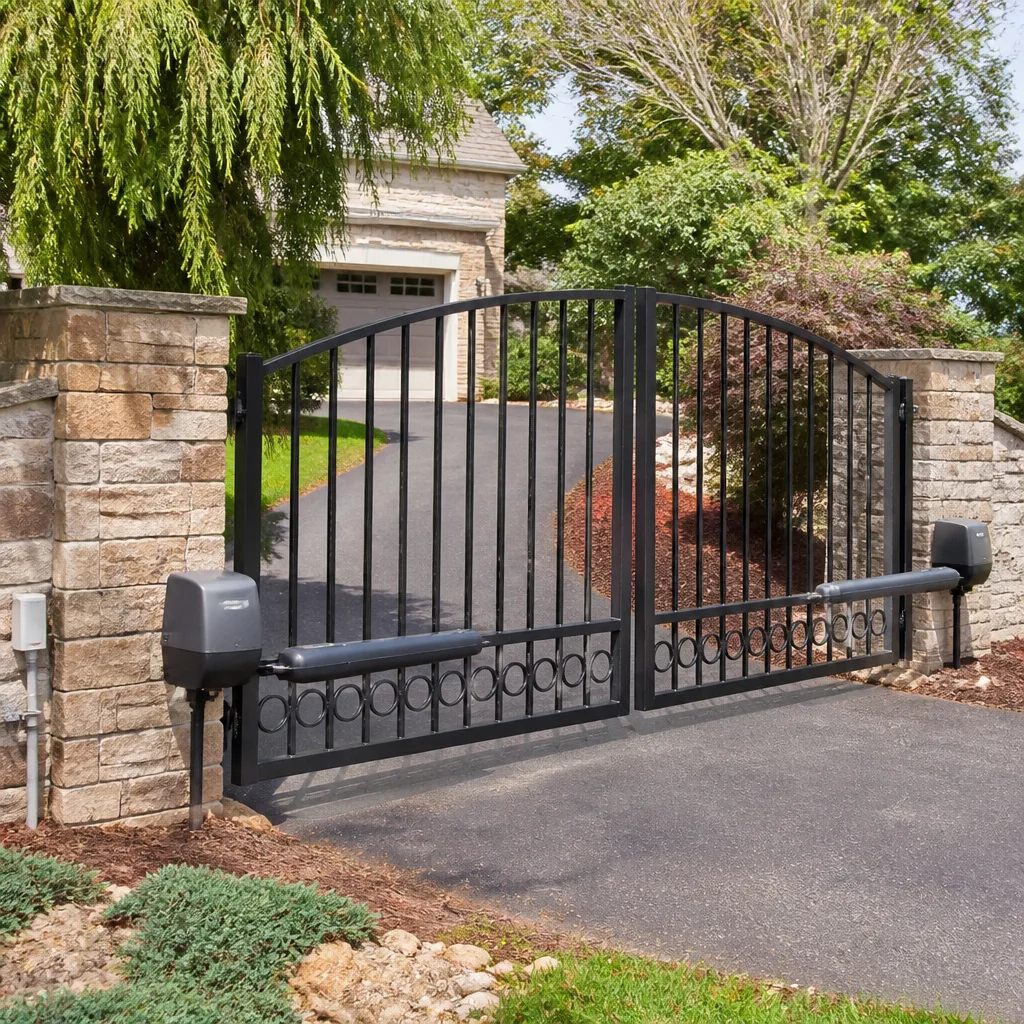
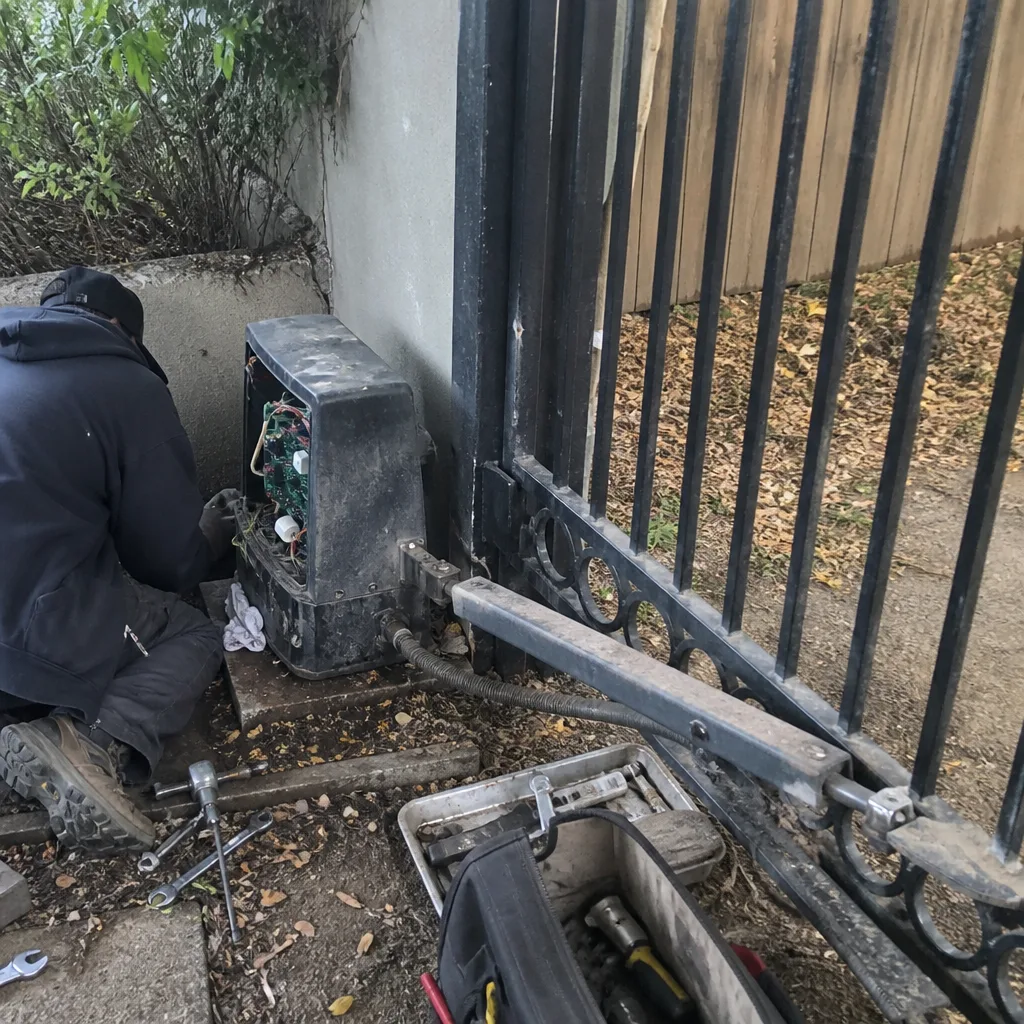 Before
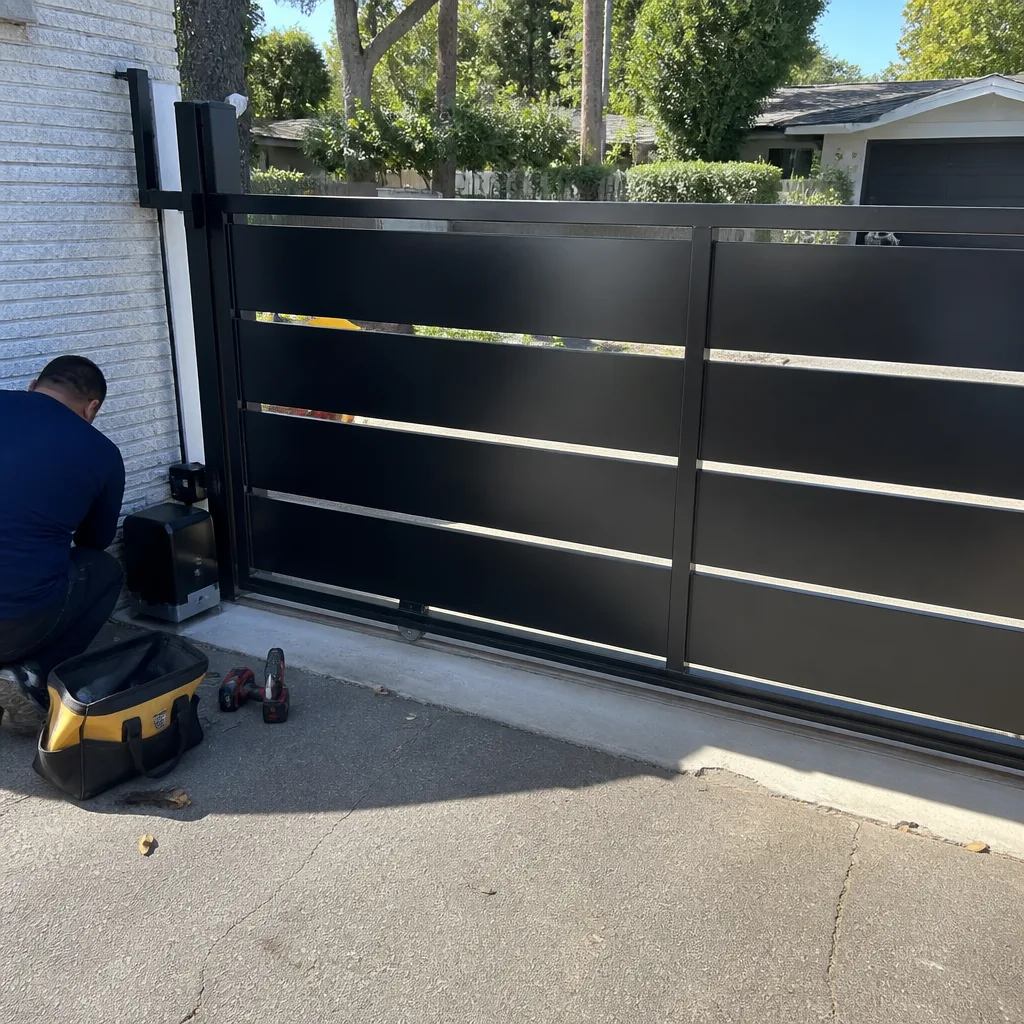 After
After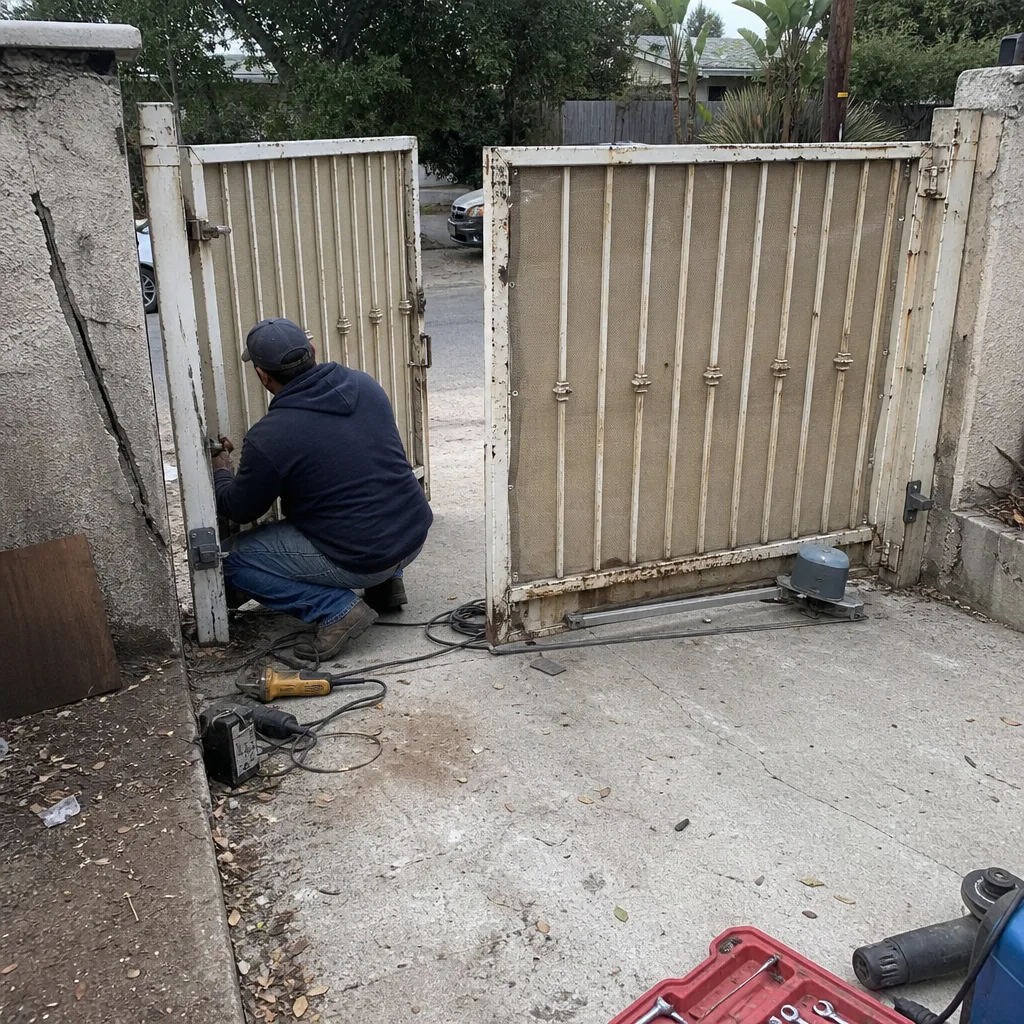 Before
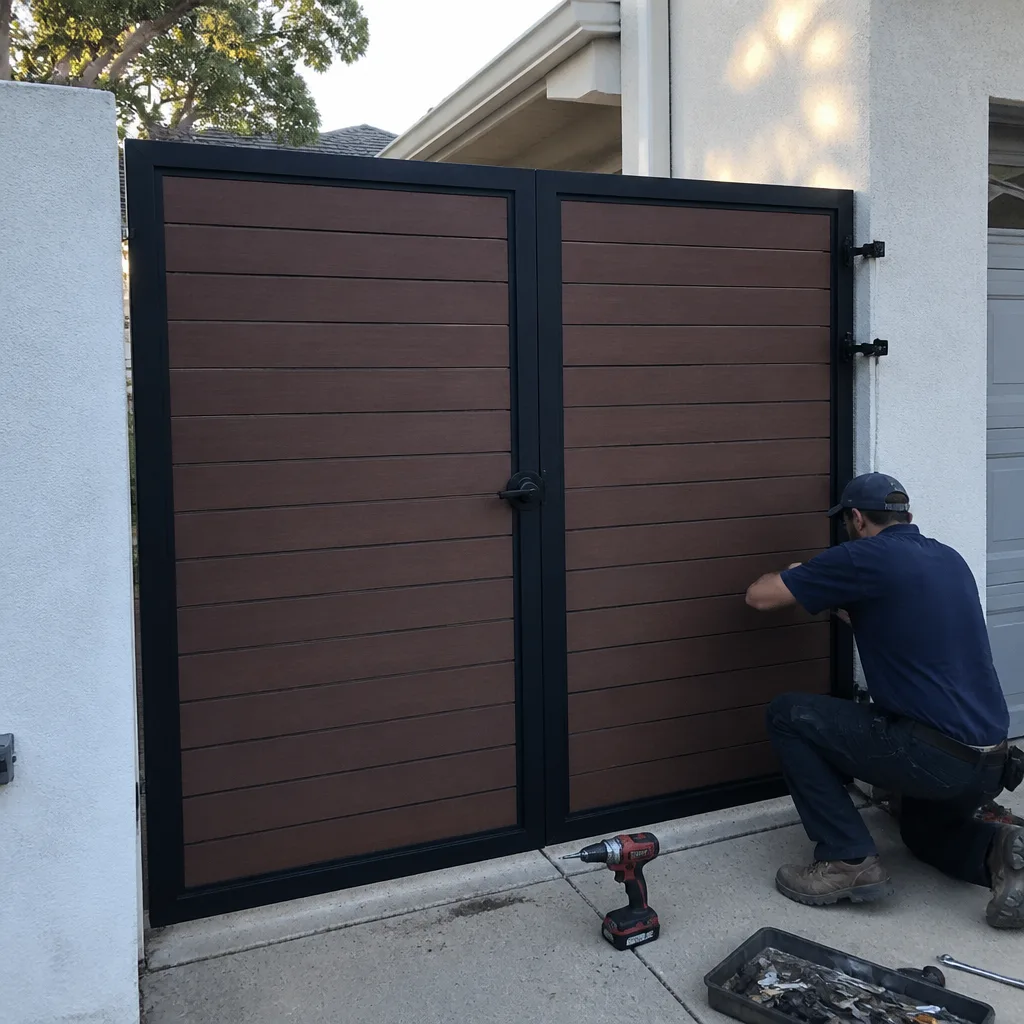 After
After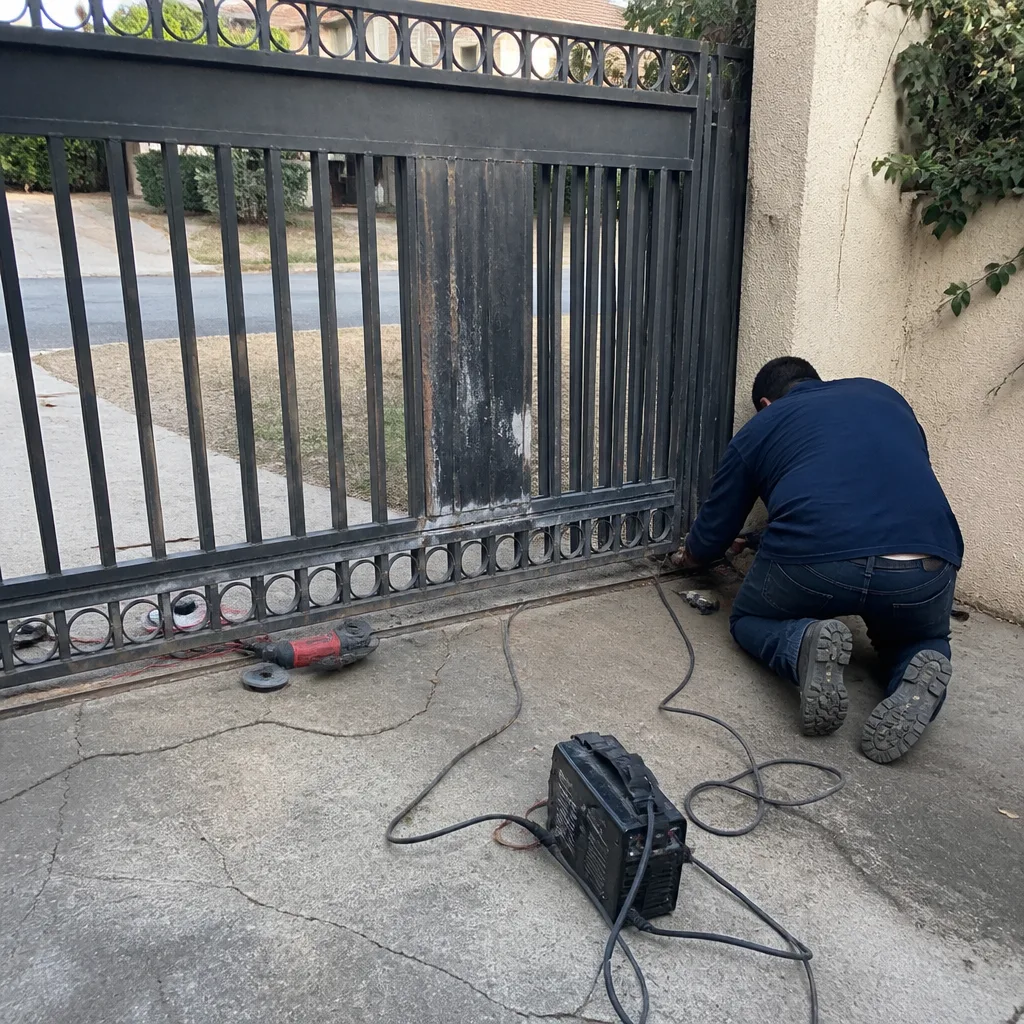 Before
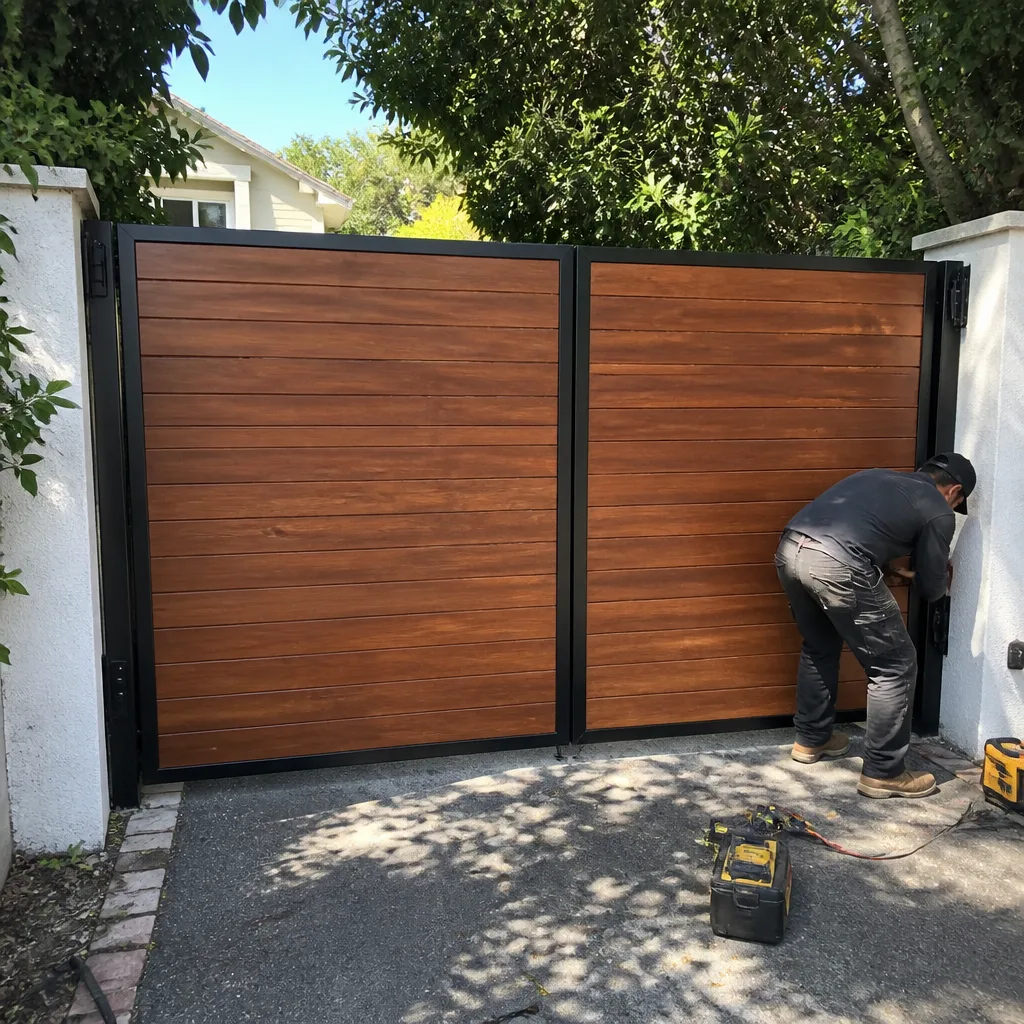 After
AfterGate Repair Permits, Codes & Inspections in CA: What You Need to Know
Most California homeowners never think about gate permits until a neighbor files a complaint, or until the day they try to sell the house. We’ve been called out to Sherman Oaks properties where a swinging driveway gate was hung twenty years ago without a permit, and it surfaced during escrow. By the end of this guide you’ll know which gate repairs are purely mechanical and which ones trigger a permit under California law, what the inspectors actually check, how much it costs when you get it wrong, and how to handle the process without losing a month of your life to a planning desk. Sherman Oaks sits inside the City of Los Angeles jurisdiction, so the rules here are specific and worth knowing cold.
Quick Answer
A standard gate repair, such as replacing hinges, a bent post, a broken opener, or a damaged picket, generally does not require a permit anywhere in California. A permit is almost always required when you install a new gate, replace a structural column or footing, run new electrical from the panel to the motor, or install an automatic opener with safety loops and photo eyes. When in doubt, the safe move in Sherman Oaks is a quick call to the LA Department of Building and Safety, or ask a licensed gate contractor who deals with these questions every week.
Table of Contents
- What Actually Triggers a Gate Permit in California
- Sherman Oaks and City of LA: The Local Rules That Matter
- Electrical and Automation Codes for Automatic Gates
- Fire Access, Setbacks, and Safety Clearance Requirements
- What the Inspector Actually Checks: A Step-by-Step Walkthrough
- What Permits and Inspections Really Cost in Sherman Oaks
- How Long the Whole Process Takes, From Filing to Final Sign-Off
- Common Mistakes to Avoid
- When to Call a Professional
- Frequently Asked Questions
- The Bottom Line
What Actually Triggers a Gate Permit in California
Here’s the framework that matters. California building code treats a gate in three different ways depending on what you’re doing to it. A repair that restores the gate to its original condition, same size, same posts, same location, no new electrical, is classified as maintenance. That does not need a permit in any California jurisdiction, including Sherman Oaks in the City of Los Angeles. Replacing a gate operator motor with a like-for-like model usually falls under the same maintenance category, although the manufacturer’s safety requirements still apply and the unit must meet current UL 325 standards.
The second category is renovation or replacement that changes the structure, the footprint, or the electrical feed. If you’re pulling out the original posts and pouring new footings, that’s a structural alteration. If you’re widening the driveway opening or moving the gate line five feet, that’s a change to the approved site plan. Both require permits. The third category is new installation. A driveway gate that never existed before is new construction, full stop. It needs a permit, plans, and inspections, no matter which city you live in.
To put it plainly for the Sherman Oaks homeowner: if the work involves a concrete saw, a trench for conduit, a new subpanel circuit, or moving a post, you’re in permit territory. If it involves a wrench, a welder on a broken hinge, or a replacement motor bolted to the existing bracket, you’re almost always in the clear.
Repairs That Don’t Usually Need a Permit
- Replacing hinges, rollers, or track hardware
- Welding a cracked gate frame or replacing bent pickets
- Swapping a broken opener motor for a comparable unit
- Replacing keypads, remotes, receivers, and safety sensors
- Straightening a leaning post when the footing is still sound
- Greasing, balancing, and seasonal tune-ups
Work That Does Need a Permit
- Installing a new gate where none existed before
- Replacing footings or pouring new concrete for posts
- Adding a dedicated electrical circuit for a gate opener
- Widening or relocating the driveway opening
- Installing a pedestrian gate with new concrete work
- Adding an automatic opener to a manual gate, when it requires new sensors and power
We tell our customers in Sherman Oaks the same thing we’d tell our own family: when you’re not sure, a fifteen-minute phone call to the building department saves you a three-month headache later. Victor Salinas has handled enough of these calls to know that the City of LA inspectors are reasonable people if you approach the process honestly.
Sherman Oaks and City of LA: The Local Rules That Matter
Sherman Oaks falls under the City of Los Angeles Department of Building and Safety, or LADBS. If your property is in the hills south of Ventura Boulevard, you may also have additional review from the Hillside Ordinance or the Mulholland Scenic Parkway Specific Plan, depending on the exact street. The Valley floor around Dixie Canyon and Royal Woods is generally straightforward, but the moment you’re above the boulevard and into the hillside areas, expect a more careful review of retaining walls, drainage, and visibility.
The practical effect for a Sherman Oaks homeowner is that gate work is governed by the 2022 California Building Code as amended by the City of Los Angeles. The City of LA has its own amendments, and many of them are stricter than the state baseline. For example, LA has specific requirements around automatic gate entrapment protection, especially on any gate serving more than one dwelling unit. A gate in a Sherman Oaks duplex or a four-unit building on Van Nuys Boulevard is treated differently than a single-family gate on a cul-de-sac off Woodman Avenue.
One specific thing we’ve learned in this market: if your Sherman Oaks home is in a designated Historic Preservation Overlay Zone, and there are a few pockets of those in the neighborhood, even a like-for-like gate replacement can require design review. The city will want to see that the new gate matches the character of the original. Most Sherman Oaks homes are not in an HPOZ, but it’s worth checking before you order custom ironwork.
The zoning code also dictates height and opacity. In most single-family residential zones in Sherman Oaks, a driveway gate may be up to 7 feet tall in a rear yard and 42 inches in a front yard, though driveway gates are typically classified as fence features. A solid metal gate over 42 inches in a front setback can run into code issues if it blocks sightlines for pedestrians and vehicles. We’ll cover that more in the fire and safety section below.
Electrical and Automation Codes for Automatic Gates
Automatic gate openers in California are regulated under UL 325, the national safety standard for automated gate systems, and enforced through the California Electrical Code. The core principle is entrapment prevention, which is the industry’s way of saying a motor should never crush, pinch, or trap a person. Every automatic gate in Sherman Oaks must have a minimum of two independent entrapment protection devices, and at least one of them must be a monitored safety device that can reverse the gate even if a sensor fails.
In plain terms: a photo eye beam across the driveway is common, but a photo eye alone is often not enough. Many designs pair the photo eye with an inherent reverse sensor built into the motor, or with a safety edge strip mounted on the gate leaf. If the gate hits something unexpected, the motor reverses direction immediately. That is not optional equipment. It is code.
The electrical feed itself is another common tripwire. A gate opener on a dedicated circuit is standard for good reason. Gate motors draw a surge at start-up, especially heavier slide gates and long leaf swing gates. Running the opener off a garage circuit that also powers a refrigerator or a workshop is a code violation in most cases, and in practice it causes nuisance trips. A dedicated 15-amp or 20-amp circuit from the main panel to the gate operator is the typical requirement.
For Sherman Oaks homeowners in the flatlands, conduit is usually shallow and straightforward. In the hills, trenching through decomposed granite and layers of fill slows the job down, and sometimes the panel is on the far side of the house, which adds significant wiring distance. We quote this honestly and specifically, because we know the neighborhoods from Burbank Boulevard up to Mulholland Drive.
On the opener brands we service, including BFT, Linear, Viking, and Ghost Controls, the safety logic, the limits, and the sensitivity settings must be dialed in after installation. A gate that closes too fast or doesn’t stop under load is a code problem and a safety problem, and the fix is never just turning a screw and walking away. It takes a trained technician and a calibration sequence that most manufacturers specify to the inch and the second.
Fire Access, Setbacks, and Safety Clearance Requirements
Fire access is the most commonly overlooked gate requirement in the Sherman Oaks hills. The Los Angeles Fire Department has a direct say in any gate that blocks a driveway longer than 150 feet, or any gate that serves a property with fire department access requirements. If LAFD cannot get a fire engine through your gate, the gate is not just non-compliant, it is a liability on the title.
There are electrical and manual override rules. Every automatic gate must have a fire department lock box, a key switch, or both, depending on the jurisdiction and the specific site. In Sherman Oaks hillside neighborhoods, we regularly see the LAFD Knox box requirement, which allows the fire department to open the gate with a master key even during a power outage. A battery backup or a manual release is also required so the gate can be opened by hand if the power is out.
Setbacks matter too. A driveway gate in Sherman Oaks must generally be set back from the sidewalk or the edge of the roadway far enough that a car can pull in and wait without blocking traffic. On lots off Sepulveda Boulevard and Ventura Boulevard, that setback is non-negotiable, because a car hanging into the travel lane while the gate opens is a real hazard. The standard is at least the length of the longest vehicle that will use the driveway, often 18 to 20 feet, and the city will look at it on the site plan.
Height and visibility are the other piece. A solid wood or solid steel gate near a street corner can blind pedestrians and cyclists. The zoning code in Los Angeles limits the opacity of gates in the front setback. Open picket ironwork or spaced bar design is usually the clean way through plan check. It looks right on a Sherman Oaks ranch house, and it satisfies the sightline rules without argument.
One thing we tell every customer who lives in a high fire severity zone, which includes most of the Sherman Oaks hills south of the boulevard: the same gate that looks beautiful and provides privacy must still open from the outside with the right key, every time, with no power. Test it the day it’s installed, and test it again before fire season. That’s the rule we live by at Ironworks Gate Co. home, and it’s saved more than one homeowner a visit from the fire marshal.
What the Inspector Actually Checks: A Step-by-Step Walkthrough
If your gate project does require a permit, the inspection is not a formality. The LADBS inspector will come to the site in Sherman Oaks with the approved plans in hand, and they’ll work through a checklist. Here’s the honest version of what they’re looking at, step by step.
- Footings and post depth. The inspector wants to see that the concrete was poured to the depth shown on the approved plans. In most Los Angeles residential zones, that’s 24 to 36 inches for a driveway gate post, deeper in expansive soil areas. If the hole was backfilled with dirt and gravel, it fails.
- Gate clearance and swing. The gate must swing or slide freely without dragging on the ground or binding on the posts. The inspector will open and close it several times. A gate that needs a shoulder to move is a failed inspection.
- Entrapment sensors. On any automatic gate, the inspector checks that the photo eyes are mounted at the correct height, the safety edge or inherent reverse is active, and the gate reverses on contact. They will test it. If it doesn’t reverse, you’re not passing.
- Electrical work. All conduit, boxes, and connections must be to code. Exposed Romex stapled to a fence post does not pass in the City of Los Angeles. The inspector will check that the circuit is dedicated and properly grounded.
- Fire department access. If required, the Knox box or key switch is verified, and the inspector may check the manual release function. In the hills, this is often the second or third item checked, and it’s a hard fail if missing.
- Workmanship and finish. Sharp edges, protruding bolts, and rough welds can be cited. The standard is a completed, professional installation, not a work in progress.
In our experience, the two most common failure points in Sherman Oaks are entrapment sensor misalignment and footings that were shallower than the plan. Both are avoidable. A good gate contractor walks the site before the inspector arrives and verifies every item on the list. We do it on every permitted job, because nobody wants to pay for a re-inspection.
What Permits and Inspections Really Cost in Sherman Oaks
The honest numbers, as of 2025, run something like this for a typical single-family driveway gate permit in the City of Los Angeles. A basic building permit for a new gate with new posts and footings typically costs between $300 and $900, depending on the valuation of the work. The valuation is the total cost of the project, including labor and materials, and LADBS calculates the permit fee as a percentage of that number.
An electrical permit for a new dedicated circuit to a gate opener typically adds another $150 to $350. If the project is in a hillside area subject to additional review, budget another $200 to $500 for the technical review and any required geology or drainage sign-offs. A re-inspection fee in Los Angeles runs about $150 to $250, which is the penalty for failing the first time.
Here’s a realistic cost rundown for a permitted new automatic driveway gate in Sherman Oaks:
- Building permit: $400 to $800
- Electrical permit: $150 to $350
- Hillside review (if applicable): $200 to $500
- Fire department review (if applicable): $100 to $300
- Re-inspection, if needed: $150 to $250 per visit
Those are the city’s fees only. The contractor’s time for plans, plan check submittal, site visits, and inspection scheduling is generally included in the project bid, but not always. We quote it as a line item so there’s no mystery. A fixed price for the gate, a fixed price for the permit process, and the inspection ride-along included. That’s how we’ve done it in Sherman Oaks for years, and it’s how a square deal should work.
How Long the Whole Process Takes, From Filing to Final Sign-Off
For a simple permit on a flat Sherman Oaks lot, the realistic timeline is two to six weeks from filing to final inspection, but most of that is waiting. The plan check at LADBS for a straightforward gate project typically takes one to two weeks. Once the permit is issued, the work itself often takes one to three days. The inspection is then scheduled, and in the Valley field offices the wait for an available inspection slot is usually a few days to two weeks.
The process looks like this:
- Day 1-7: Site visit, measurements, and plan preparation.
- Week 1-3: Submit to LADBS, pay fees, plan check review.
- Week 3-4: Permit issued, work scheduled.
- Week 4-5: Gate installed, electrical connected, safety devices calibrated.
- Week 5-6: Inspection scheduled and passed, final sign-off logged.
Hillside properties in Sherman Oaks add time. A project above the boulevard with retaining walls nearby or a long driveway off Mulholland can add two to four weeks for the extra reviews. The lesson here is not to file the permit after you’ve already scheduled a family event that requires the gate to be working. File early, expect the waiting, and the job goes smoothly.
There’s also a useful shortcut for simple repairs. If the work is genuinely maintenance, no permit means no plan check and no inspection. That’s one of the reasons it pays to have a knowledgeable gate contractor assess the work first. We’ve seen $2,000 repair jobs turned into $6,000 permit projects by a well-meaning generalist who didn’t know the difference.
Common Mistakes to Avoid
- Skipping the permit because the neighbor skipped theirs. Your neighbor’s unpermitted gate is not a legal precedent. When you sell the house, the buyer’s lender will ask. Fix it now or pay more later.
- Pulling the permit but not the electrical permit. A building permit for the gate structure does not cover new electrical. Running power to a gate opener without an electrical permit is a common citation, and it voids your insurance coverage on that circuit.
- Pouring shallow footings. Some contractors dig two feet because it’s easier. In Sherman Oaks clay soil, two feet doesn’t survive the first heavy winter. The code says what it says for a reason.
- Buying a cheap opener without UL 325 compliance. An automatic gate motor that isn’t UL 325 listed is not legal to install in California, full stop. It will fail inspection, and it’s a liability you don’t want.
- Ignoring the fire access requirement. In the hills, this is the most expensive mistake. LAFD will flag it, and you’ll be installing a Knox box and a battery backup after the fact, at a higher cost than doing it from the start.
- Thinking a permit and an inspection are the same thing. The permit is the permission to build. The inspection is the proof that it was built right. You need both. A permit with no final inspection is an open item on your property record.
- Using a handyman for a permitted gate project. A $50-an-hour handyman can’t pull a permit in the City of LA unless they’re a licensed contractor, and the minute the inspector sees the work, the mistakes become expensive. The second fix always costs more than the first right job would have.
When to Call a Professional
You can likely handle a keypad battery or a loose hinge bolt on your own. The moment the project involves concrete, electrical, a motor, or an inspection, bring in a licensed gate contractor. We recommend it even for the assessment, because a professional eye can tell you whether a leaning post is a thirty-minute repair or a full footing replacement, and the difference is thousands of dollars.
If you’re in Sherman Oaks or the surrounding Valley, Ironworks Gate Co. offers free estimates on gate repair, replacement, and automation work. Call (925) 590-4289 and a live person answers, day or night. We’ll tell you honestly whether you need a permit for your specific project, what it should cost, and how long it will take. No pressure, no jargon, no surprises.
Frequently Asked Questions
If you’re replacing the gate leaf, hinges, and hardware on the existing posts, and not moving any concrete or adding new electrical, you generally do not need a permit. Call (925) 590-4289 and we’ll tell you straight, based on the details of your specific site.
A basic building permit for a new gate in the City of Los Angeles typically runs between $400 and $800, plus an electrical permit of $150 to $350 if you’re adding a dedicated circuit for an opener. Hillside reviews and fire department reviews can add more.
If the opener is a like-for-like replacement on an existing motor mount and no new electrical is required, it typically falls under maintenance. If you’re adding a new opener to a manual gate with new power and sensors, a permit is required, and the work must meet UL 325 safety standards.
A Knox box is a fire department access device that lets LAFD open your gate with a master key during an emergency. It’s commonly required on Sherman Oaks hillside properties and long driveways. Your permit review will specify whether and where it’s needed.
You’ll receive a correction notice listing exactly what’s out of compliance, and you’ll pay a re-inspection fee to have the inspector return. Most failures are fixable in a day, but it’s cheaper and faster to have the work checked before the inspector arrives.
It’s a strong start, but the fire department will also want the approved access method, usually a Knox box or a key switch, and they may want the gate to open wide enough for a fire engine. The specific requirements depend on your home’s location in Sherman Oaks.
The Bottom Line
Most gate repairs in California don’t need a permit, and most gate installations do. The dividing line is structural work and electrical work. Know which side of the line your project falls on before you start. In Sherman Oaks, the rules come from the City of Los Angeles and, in the hills, from the fire department, and both are enforced at inspection. A licensed gate contractor who handles permits regularly will save you time, money, and a failed inspection. Done right, and backed in writing, a gate is a forty-year asset. Done wrong, it’s a lien on your title and a headache you’ll explain to a buyer one day. Call us before you dig, and you’ll know exactly where you stand.
Written by Victor Salinas, Owner at Ironworks Gate Co., serving Sherman Oaks since 2013.